Tuesday, January 22, 2013

The Conquest of Mecca

The Constitution of Medina - under which the clans accepting Muhammad as the Prophet of God formed an alliance, or federation - dates from this period.  It showed that the political consciousness of the Muslim community had reached an important point; its members defined themselves as a community separate from all others.  The Constitution also defined the role of non-Muslims in the community.  Jews, for example, were part of the community; they were dhimmis, that is, protected people, as long as they conformed to its laws.  This established a precedent for the treatment of subject peoples during the later conquests.  Christians and Jews, upon payment of a nominal tax, were allowed religious freedom and, while maintaining their status as non-Muslims, were associate members of the Muslim state.  This status did not apply to polytheists, who could not be tolerated within a community that worshipped the One God.
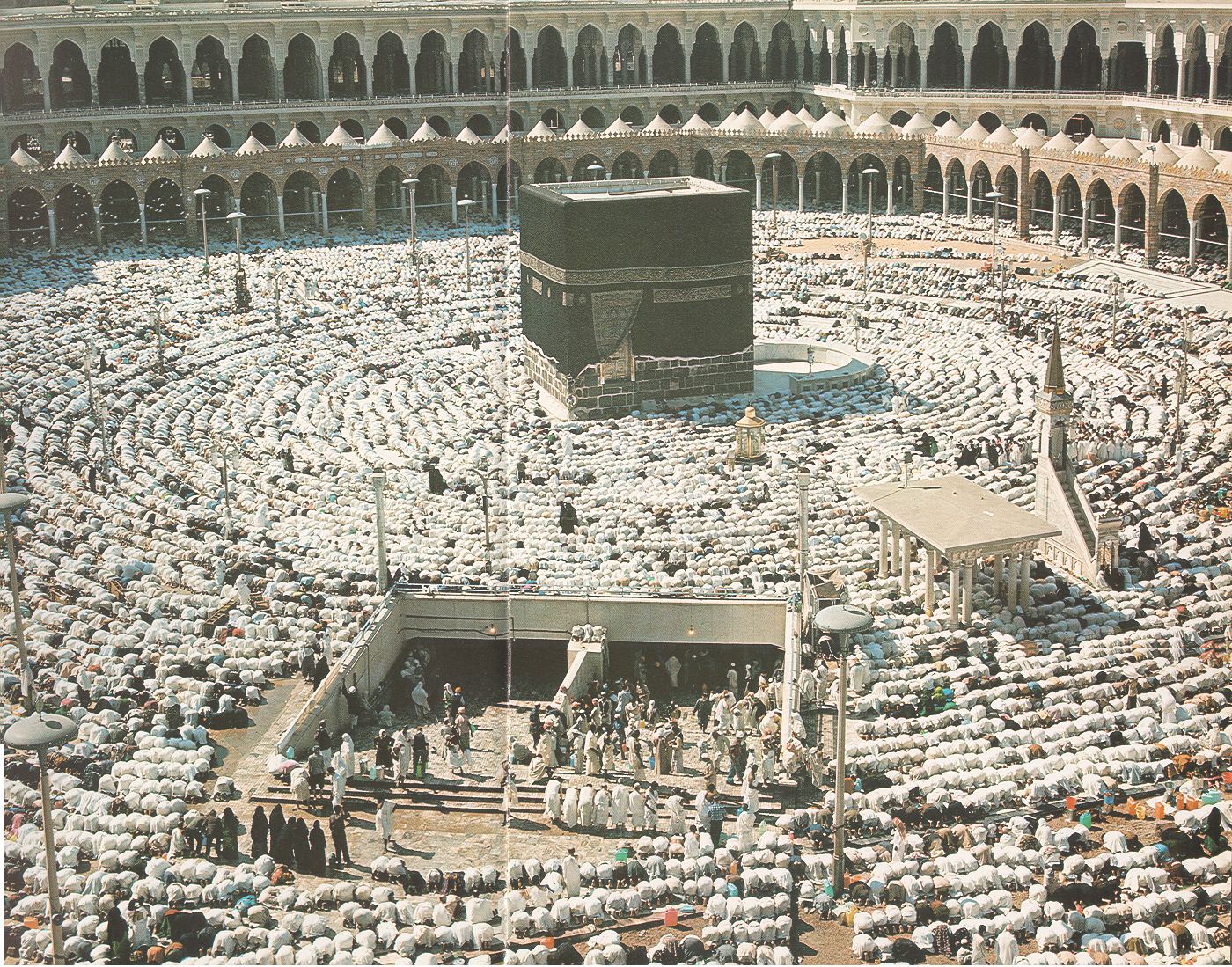
Ibn Ishaq, one of the earliest biographers of the Prophet, says it was at about this time that Muhammad sent letters to the rulers of the earth - the King of Persia, the Emperor of Byzantium, the Negus of Abyssinia, and the Governor of Egypt among others - inviting them to submit to Islam.  Nothing more fully illustrates the confidence of the small community, as its military power, despite the battle of the Trench, was still negligible.  But its confidence was not misplaced.  Muhammad so effectively built up a series of alliances among the tribes that, by 628, he and fifteen hundred followers were able to demand access to the Kaaba.  This was a milestone in the history of the Muslims.  Just a short time before, Muhammad left the city of his birth to establish an Islamic state in Medina.  Now he was being treated by his former enemies as a leader in his own right.  A year later, in 629, he reentered and, in effect, conquered Mecca, without bloodshed and in a spirit of tolerance, which established an ideal for future conquests.  He also destroyed the idols in the Kaabah, to put an end forever to pagan practices there.  At the same time ‘Amr ibn al-’As, the future conqueror of Egypt, and Khalid ibn al-Walid, the future “Sword of God,” accepted Islam, and swore allegiance to Muhammad.  Their conversion was especially noteworthy because these men had been among Muhammad’s bitterest opponents only a short time before.
In one sense Muhammad’s return to Mecca was the climax of his mission.  In 632, just three years later, he was suddenly taken ill and on June 8 of that year, with his third wife Aisha in attendance, the Messenger of God “died with the heat of noon.”
The death of Muhammad was a profound loss.  To his followers this simple man from Mecca was far more than a beloved friend, far more than a gifted administrator, far more than the revered leader who had forged a new state from clusters of warring tribes.  Muhammad was also the exemplar of the teachings he had brought them from God: the teachings of the Quran, which, for centuries, have guided the thought and action, the faith and conduct, of innumerable men and women, and which ushered in a distinctive era in the history of mankind.  His death, nevertheless, had little effect on the dynamic society he had created in Arabia, and no effect at all on his central mission: to transmit the Quran to the world.  As Abu Bakr put it: “Whoever worshipped Muhammad, let him know that Muhammad is dead, but whoever worshipped God, let him know that God lives and dies not.”

The Hijrah

After Muhammad had preached publicly for more than a decade, the opposition to him reached such a high pitch that, fearful for their safety, he sent some of his adherents to Ethiopia.  There, the Christian ruler extended protection to them, the memory of which has been cherished by Muslims ever since.  But in Mecca the persecution worsened.  Muhammad’s followers were harassed, abused, and even tortured.  At last, seventy of Muhammad’s followers set off by his orders to the northern town of Yathrib, in the hope of establishing a news stage of the Islamic movement.  This city which was later to be renamed Medina (“The City”).  Later, in the early fall of 622, he, with his closest friend, Abu Bakr al-Siddeeq, set off to join the emigrants.  This event coincided with the leaders in Mecca plotting, to kill him.
In Mecca, the plotters arrived at Muhammad’s home to find that his cousin, ‘Ali, had taken his place in bed.  Enraged, the Meccans set a price on Muhammad’s head and set off in pursuit.  Muhammad and Abu Bakr, however, had taken refuge in a cave, where they hid from their pursuers.  By the protection of God, the Meccans passed by the cave without noticing it, and Muhammad and Abu Bakr proceeded to Medina.  There, they were joyously welcomed by a throng of Medinans, as well as the Meccans who had gone ahead to prepare the way.
This was the Hijrah - anglicized as Hegira - usually, but inaccurately, translated as “Flight” - from which the Muslim era is dated.  In fact, the Hijrah was not a flight, but a carefully planned migration that marks not only a break in history - the beginning of the Islamic era - but also, for Muhammad and the Muslims, a new way of life.  Henceforth, the organizational principle of the community was not to be mere blood kinship, but the greater brotherhood of all Muslims.  The men who accompanied Muhammad on the Hijrah were called the Muhajiroon - “those that made the Hijrah” or the “Emigrants” - while those in Medina who became Muslims were called the Ansar, or “Helpers.”
Muhammad was well acquainted with the situation in Medina.  Earlier, before the Hijrah, various of its inhabitants came to Mecca to offer the annual pilgrimage, and as the Prophet would take this opportunity to call visiting pilgrims to Islam, the group who came from Medina heard his call and accepted Islam..  They also invited Muhammad to settle in Medina.  After the Hijrah, Muhammad’s exceptional qualities so impressed the Medinans that the rival tribes and their allies temporarily closed ranks as, on March 15, 624, Muhammad and his supporters moved against the pagans of Mecca.
The first battle, which took place near Badr, now a small town southwest of Medina, had several important effects.  In the first place, the Muslim forces, outnumbered three to one, routed the Meccans.  Secondly, the discipline displayed by the Muslims brought home to the Meccans, perhaps for the first time, the abilities of the man they had driven from their city.  Thirdly, one of the allied tribes which had pledged support to the Muslims in the Battle of Badr, but had then proved lukewarm when the fighting started, was expelled from Medina one month after the battle.  Those who claimed to be allies of the Muslims, but tacitly opposed them, were thus served warning: membership in the community imposed the obligation of total support.
A year later the Meccans struck back.  Assembling an army of three thousand men, they met the Muslims at Uhud, a ridge outside Medina.  After initial successes, the Muslims were driven back and the Prophet himself was wounded.  As the Muslims were not completely defeated, the Meccans, with an army of ten thousand, attacked Medina again two years later but with quite different results.  At the Battle of the Trench, also known as the Battle of the Confederates, the Muslims scored a signal victory by introducing a new form of defense.  On the side of Medina from which attack was expected, they dug a trench too deep for the Meccan cavalry to clear without exposing itself to the archers posted behind earthworks on the Medina side.  After an inconclusive siege, the Meccans were forced to retire.  Thereafter Medina was entirely in the hands of the Muslims.

Islam Religius History


In or about the year 570 the child who would be named Muhammad and who would become the Prophet of one of the world’s great religions, Islam, was born into a family belonging to a clan of Quraish, the ruling tribe of Mecca, a city in the Hijaz region of northwestern Arabia.
Originally the site of the Kaabah, a shrine of ancient origins, Mecca had, with the decline of southern Arabia, become an important center of sixth-century trade with such powers as the Sassanians, Byzantines, and Ethiopians.  As a result, the city was dominated by powerful merchant families, among whom the men of Quraish were preeminent.
Muhammad’s father, “Abd Allah ibn” Abd al-Muttalib, died before the boy was born; his mother, Aminah, died when he was six.  The orphan was consigned to the care of his grandfather, the head of the clan of Hashim.  After the death of his grandfather, Muhammad was raised by his uncle, Abu Talib.  As was customary, the child Muhammad was sent to live for a year or two with a Bedouin family.  This custom, followed until recently by noble families of Mecca, Medina, Taif, and other towns of the Hijaz, had important implications for Muhammad.  In addition to enduring the hardships of desert life, he acquired a taste for the rich language so loved by the Arabs, whose speech was their proudest art, and also learned the patience and forbearance of the herdsmen, whose life of solitude he first shared, and then came to understand and appreciate.
About the year 590, Muhammad, then in his twenties, entered the service of a merchant widow named Khadijah as her factor, actively engaged with trading caravans to the north.  Sometime later he married her, and had two sons, neither of whom survived, and four daughters by her.
In his forties, he began to retire to meditate in a cave on Mount Hira, just outside Mecca, where the first of the great events of Islam took place.  One day, as he was sitting in the cave, he heard a voice, later identified as that of the Angel Gabriel, which ordered him to:
“Recite: In the name of thy Lord who created, Created man from a clot of blood.” (Quran 96:1-2)
Three times Muhammad pleaded his inability to do so, but each time the command was repeated.  Finally, Muhammad recited the words of what are now the first five verses of the 96th chapter of the Quran - words which proclaim God to be the Creator of man and the Source of all knowledge.
At first Muhammad divulged his experience only to his wife and his immediate circle.  But, as more revelations enjoined him to proclaim the oneness of God universally, his following grew, at first among the poor and the slaves, but later, also among the most prominent men of Mecca.  The revelations he received at this time, and those he did later, are all incorporated in the Quran, the Scripture of Islam.
Not everyone accepted God’s message transmitted through Muhammad.  Even in his own clan, there were those who rejected his teachings, and many merchants actively opposed the message.  The opposition, however, merely served to sharpen Muhammad’s sense of mission, and his understanding of exactly how Islam differed from paganism.  The belief in the Oneness of God was paramount in Islam; from this all else follows.  The verses of the Quran stress God’s uniqueness, warn those who deny it of impending punishment, and proclaim His unbounded compassion to those who submit to His will.  They affirm the Last Judgment, when God, the Judge, will weigh in the balance the faith and works of each man, rewarding the faithful and punishing the transgressor.  Because the Quran rejected polytheism and emphasized man’s moral responsibility, in powerful images, it presented a grave challenge to the worldly Meccans.

Monday, December 17, 2012

Religion in ancient Rome

Religion in ancient Rome encompasses the practices and beliefs the ancient Romans regarded as their own, as well as the many cults imported to Rome or practiced by peoples under Roman rule.

The Romans thought of themselves as highly religious, and attributed their success as a world power to their collective piety (pietas) in maintaining good relations with the gods. According to legendary history, most of Rome's religious institutions could be traced to its founders, particularly Numa Pompilius, the Sabine second king of Rome, who negotiated directly with the gods. This archaic religion was the foundation of the mos maiorum, "the way of the ancestors" or simply "tradition", viewed as central to Roman identity.

The priesthoods of public religion were held by members of the elite classes. There was no principle analogous to "separation of church and state" in ancient Rome. During the Roman Republic (509 BC–27 BC), the same men who were elected public officials might also serve as augurs and pontiffs. Priests married, raised families, and led politically active lives. Julius Caesar became Pontifex Maximus before he was elected consul. The augurs read the will of the gods and supervised the marking of boundaries as a reflection of universal order, thus sanctioning Roman expansionism as a matter of divine destiny. The Roman triumph was at its core a religious procession in which the victorious general displayed his piety and his willingness to serve the public good by dedicating a portion of his spoils to the gods, especially Jupiter, who embodied just rule. As a result of the Punic Wars (264–146 BC), when Rome struggled to establish itself as a dominant power, many new temples were built by magistrates in fulfillment of a vow to a deity for assuring their military success.

Roman religion was thus practical and contractual, based on the principle of do ut des, "I give that you might give." Religion depended on knowledge and the correct practice of prayer, ritual, and sacrifice, not on faith or dogma, although Latin literature preserves learned speculation on the nature of the divine and its relation to human affairs. Even the most skeptical among Rome's intellectual elite such as Cicero, who was an augur, saw religion as a source of social order.

For ordinary Romans, religion was a part of daily life. Each home had a household shrine at which prayers and libations to the family's domestic deities were offered. Neighborhood shrines and sacred places such as springs and groves dotted the city. Apuleius described the everyday quality of religion in observing how people who passed a cult place might make a vow or a fruit offering, or merely sit for a while. The Roman calendar was structured around religious observances. In the Imperial era, as many as 135 days of the year were devoted to religious festivals and games (ludi). Women, slaves, and children all participated in a range of religious activities. Some public rituals could be conducted only by women, and women formed what is perhaps Rome's most famous priesthood, the state-supported Vestal Virgins, who tended Rome's sacred hearth for centuries, until disbanded under Christian domination.

The Romans are known for the great number of deities they honored, a capacity that earned the mockery of early Christian polemicists. The presence of Greeks on the Italian peninsula from the beginning of the historical period influenced Roman culture, introducing some religious practices that became as fundamental as the cult of Apollo. The Romans looked for common ground between their major gods and those of the Greeks, adapting Greek myths and iconography for Latin literature and Roman art. Etruscan religion was also a major influence, particularly on the practice of augury, since Rome had once been ruled by Etruscan kings.

Imported mystery religions, which offered initiates salvation in the afterlife, were a matter of personal choice for an individual, practiced in addition to carrying on one's family rites and participating in public religion. The mysteries, however, involved exclusive oaths and secrecy, conditions that conservative Romans viewed with suspicion as characteristic of "magic", conspiracy (coniuratio), and subversive activity. Sporadic and sometimes brutal attempts were made to suppress religionists who seemed to threaten traditional morality and unity, as with the senate's efforts to restrict the Bacchanals in 186 BC.

As the Romans extended their dominance throughout the Mediterranean world, their policy in general was to absorb the deities and cults of other peoples rather than try to eradicate them, since they believed that preserving tradition promoted social stability. One way that Rome incorporated diverse peoples was by supporting their religious heritage, building temples to local deities that framed their theology within the hierarchy of Roman religion. Inscriptions throughout the Empire record the side-by-side worship of local and Roman deities, including dedications made by Romans to local gods. By the height of the Empire, numerous international deities were cultivated at Rome and had been carried to even the most remote provinces, among them Cybele, Isis, Epona, and gods of solar monism such as Mithras and Sol Invictus, found as far north as Roman Britain. Because Romans had never been obligated to cultivate one god or one cult only, religious tolerance was not an issue in the sense that it is for competing monotheistic systems. The monotheistic rigor of Judaism posed difficulties for Roman policy that led at times to compromise and the granting of special exemptions, but sometimes to intractable conflict.

In the wake of the Republic's collapse, state religion had adapted to support the new regime of the emperors. Augustus, the first Roman emperor, justified the novelty of one-man rule with a vast program of religious revivalism and reform. Public vows formerly made for the security of the republic now were directed at the wellbeing of the emperor. So-called "emperor worship" expanded on a grand scale the traditional Roman veneration of the ancestral dead and of the Genius, the divine tutelary of every individual. Imperial cult became one of the major ways Rome advertised its presence in the provinces and cultivated shared cultural identity and loyalty throughout the Empire. Rejection of the state religion was tantamount to treason. This was the context for Rome's conflict with Christianity, which Romans variously regarded as a form of atheism and novel superstitio.

From the 2nd century onward, the Church Fathers began to condemn the diverse religions practiced throughout the Empire collectively as "pagan." In the early 4th century, Constantine I became the first emperor to convert to Christianity, launching the era of Christian hegemony. The emperor Julian made a short-lived attempt to revive traditional and Hellenistic religion and to affirm the special status of Judaism, but in 391 under Theodosius I Nicene Christianity became the official state church of the Roman Empire, to the exclusion of all others. Pleas for religious tolerance from traditionalists such as the senator Symmachus (d. 402) were rejected, and Christian monotheism became a feature of Imperial domination. Heretics as well as non-Christians were subject to exclusion from public life or persecution, but Rome's original religious hierarchy and many aspects of its ritual influenced Christian forms, and many pre-Christian beliefs and practices survived in Christian festivals and local traditions.
Religion in ancient Greece

Greek religion (alternatively Hellenismos) encompasses the collection of beliefs and rituals practiced in ancient Greece in the form of both popular public religion and cult practices. These different groups varied enough for it to be possible to speak of Greek religions or "cults" in the plural, though most of them shared similarities. Also, the Greek religion extended out of Greece and out to other islands.

Many Greek people recognized the major gods and goddesses: Zeus, Poseidon, Hades, Apollo, Artemis, Aphrodite, Ares, Dionysus, Hephaestus, Athena, Hermes, Demeter, Heracles, Hestia, Asclepius and Hera though philosophies such as Stoicism and some forms of Platonism used language that seems to posit a transcendent single deity. Different cities often worshipped the same deities, sometimes with epithets that distinguished them and specified their local nature.

The religious practices of the Greeks extended beyond mainland Greece, to the islands and coasts of Ionia in Asia Minor, to Magna Graecia (Sicily and southern Italy), and to scattered Greek colonies in the Western Mediterranean, such as Massalia (Marseille). Greek religion was tempered by Etruscan cult and belief to form much of the later Ancient Roman religion.

Indian religions

Indian religions, also known as dharmic religions, are the religions that originated in the Indian subcontinent; namely Hinduism, Jainism, Buddhism and Sikhism. These religions are also classified as Eastern religions. Although Indian religions are connected through the history of India, they constitute a wide range of religious communities and Indian religions are not confined to the Indian subcontinent.

The documented history of Indian religions begins with the historical Vedic religion, the religious practices of the early Indo-Aryans, which were collected and later redacted into the Samhitas (usually known as the Vedas), four canonical collections of hymns or mantras composed in archaic Sanskrit. These texts are the central shruti (revealed) texts of Hinduism. The period of the composition, redaction and commentary of these texts is known as the Vedic period, which lasted from roughly 2000 to 1500 BCE. Certain scholarship holds that the practices, emblems and architecture now commonly associated with the Hindu pantheon and Jainism may go back as far as Late Harappan times to the period 2000–1500 BCE. The late Vedic period (9th to 6th centuries BCE) marks the beginning of the Upanisadic or Vedantic period. This period heralded the beginning of much of what became classical Hinduism, with the composition of the Upanishads, later the Sanskrit epics, still later followed by the Puranas.

Indian philosophy is a confluence of Śramaṇic (self-reliant) and Vedic streams that co-exist and influence each other. Jainism and Buddhism belong to the sramana tradition. Jainism was established by a lineage of 24 enlightened beings culminating with Parsva (9th century BCE) and Mahavira (6th century BCE). Buddhism was historically founded by Siddhartha Gautama, a Kshatriya prince-turned-ascetic, and was spread beyond India through missionaries. It later experienced a decline in India, but survived in Nepal and Sri Lanka, and remains more widespread in Southeast and East Asia.

Hinduism is divided into numerous denominations, primarily Shaivism, Shaktism, Vaishnavism, Smarta and much smaller groups like the conservative Shrauta. Hindu reform movements are more recent. About 90% of Hindus reside in the Republic of India, accounting for 83% of its population. Sikhism was founded in the 15th century on the teachings of Guru Nanak and the nine successive Sikh Gurus in Northern India. The vast majority of its adherents originate in the Punjab region.

Religions

The three main Abrahamic religions have certain similarities. All are monotheistic, and conceive God to be a transcendent Creator-figure and the source of moral law, and their sacred narratives feature many of the same figures, histories, and places in each, although they often present them with different roles, perspectives, and meanings. They also have many internal differences based on details of doctrine and practice. Christianity divided into three main branches (Catholic, Orthodox, and Protestant), dozens of significant denominations, and even more smaller ones. Islam has two main branches (Sunni and Shi'a), each having a number of denominations. Judaism also has a small number of branches, of which the most significant are Orthodox, Conservative, and Reform.